Curler: torque, temperature and intermittent handling
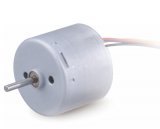
The manufacturer's JRB-320VH page names automatic curlers as its typical application and shows an outline illustration in millimetres. A hair-handling mechanism can see load changes or a snag as a strand enters the chamber. The public page does not give a readable torque-speed curve or a certified hot-enclosure operating limit, so its application label alone cannot prove a proposed winding will avoid stall or overheating.
Confirm before ordering Supply chamber and geartrain drawings, required direction and speed under hair load, snag/stop conditions, heater proximity, duty cycle and control supply. Request the exact motor/controller code, shaft and mounting drawing, torque-speed test, temperature-rise result and jam protection demonstration.
View JRB-320VH miniature brushless motor →
Clipper: cutting load and blade-drive geometry
The official JRB-370VH page identifies a hair clipper, not a curler, as its example use. For a clipper, the motor choice has to work with the blade transmission, oscillation or reduction mechanism, noise and vibration limits, battery sag and repeated start-stop operation. The catalogue picture is not a blade-drive compatibility certificate.
Confirm before ordering Send blade-drive kinematics and cutting-load measurements, required speed at the blade, battery range, enclosure acoustics, mounting and connector details. Ask for a sample tested in the complete clipper and for the motor's actual operating current, thermal margin and expected service conditions.
Bladeless fan: airflow rather than cutting torque
JRB-750VH is listed for a bladeless fan. Its load is primarily aerodynamic, so airflow, pressure, acoustic signature and continuous thermal behaviour matter more than a hand tool's momentary cutting force. No common numerical rating can be transferred from JRB-320VH or JRB-370VH simply because the JRB prefix is shared.
Confirm before ordering Provide impeller and duct geometry, target airflow/pressure curve, speed range, continuous ambient temperature, vibration/noise limits and supply electronics. Request the selected assembly's fan curve, electrical efficiency and temperature rise at the intended operating point.




 LinkedIn
 Facebook
 X
 WhatsApp
 Email