


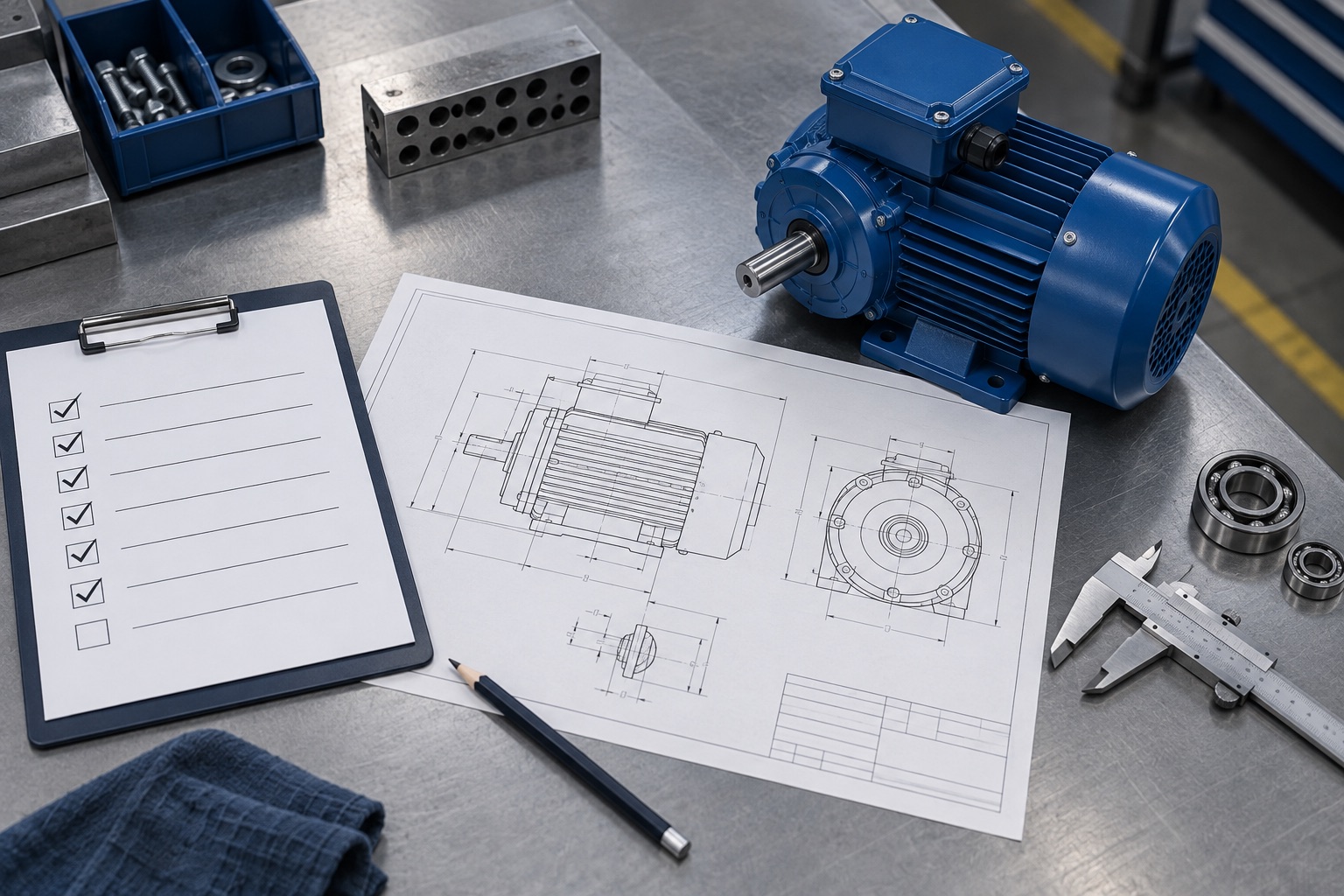
A motor inquiry often starts with a power rating and a photograph. Those can identify a product family, but they rarely define a complete purchase. Two quotations may appear comparable while covering different mounting arrangements, controls, accessories or acceptance conditions.
This guide helps procurement and engineering teams prepare one consistent brief. The aim is to make supplier differences visible before a sample order, rather than discovering them during assembly. Treat every unspecified field as an open question, and ask each supplier to state its assumptions in the quotation.
Start with the machine and its operating task
Describe what the motor drives. A pump, conveyor, washing machine and positioning axis raise different selection questions. Include the load, expected operating pattern, installation space and any existing machine interface. A replacement project should identify what must remain interchangeable; a new design should distinguish fixed requirements from dimensions that can still change.
Explain whether your request covers only the motor or a complete drive package. If a gearbox, brake, encoder, controller, cable or connector is required, list each item. A catalogue photograph is useful as a reference, but it is not a substitute for a bill of materials and an approved drawing.
Separate requirements from preferences
Mark which conditions are mandatory and which are negotiable. For example, a mounting interface may be fixed by an existing assembly while the supplier can propose a different winding or connector. This avoids rejecting a workable alternative merely because its catalogue description uses different terminology.
Document the electrical supply and controls
State the available supply, phase and frequency, together with any permitted variation defined by the project. If the motor operates with a controller or inverter, identify the controller and provide its relevant documentation. Ask the supplier to confirm the proposed motor and controller combination rather than assuming two separately quoted parts form a compatible system.
For electronically controlled motors, include the command interface and feedback requirements. Request connector pinouts and the applicable wiring diagram. Record whether the controller is included in the commercial price, supplied separately or expected to be provided by your engineering team.
Define mechanical output and installation
Provide the required operating speed and load information from the machine specification. Where torque varies through a cycle, share the profile rather than a single peak value. Ask the supplier to identify continuous and intermittent limits in the offered configuration and to explain which operating conditions those limits depend on.
Attach a dimensioned drawing for the shaft, flange, mounting holes and available installation envelope. Include coupling and gearbox interfaces where relevant. Ask for a proposed outline drawing with a revision identifier, then include the accepted revision in the eventual purchase documentation.
Describe duty and the operating environment
Document the operating cycle, starts and stops, intended hours of use and expected idle periods. Record the ambient conditions and any exposure to water, dust, chemicals or washdown. If the application involves a hazardous location, give the project classification and involve the responsible technical specialist in evaluating the offered equipment.
Do not translate a generic phrase such as “industrial use” into an assumed protection rating. Ask for the exact rating and supporting documentation for the proposed model. A certificate for a company or a different product family does not by itself describe the motor in your quotation.
Make commercial quotations comparable
Give the sample quantity, expected initial order and approximate recurring demand if known. State the delivery destination and ask each supplier to identify the delivery basis, packaging, quotation currency, validity and lead time. Keep tooling, development charges, accessories and recurring unit cost as separate entries.
Ask what happens between a sample approval and a production release. Establish which drawings, test results or signed specifications must be agreed before manufacturing. Include the procedure for notifying you of a material or component change that affects the approved configuration.
Request documents tied to the offered model
A useful response should identify the manufacturer, model, configuration and revision. Request the current datasheet, dimensional drawing, connection information and relevant test or conformity documents. Keep the document version beside the quotation so later comparisons use the same reference.
If a requirement remains unconfirmed, label it explicitly. A blank field should not be read as approval. Before selecting a supplier, resolve differences in technical scope and document which questions remain for sample evaluation.
Send one brief, keep separate supplier conversations
MotorSourcing lets buyers shortlist manufacturers and submit a common inquiry. Use that shared brief as the baseline, then keep each supplier's proposed configuration and clarifications in its own conversation. This makes it easier to compare equivalent scopes and to see where a supplier has offered an alternative.
The directory is a starting point for research. Manufacturer catalogue information can help identify candidate product families; suitability, availability and final commercial terms still need confirmation with the selected supplier. Save the approved specification with your purchasing records before placing the order.
Sources & editorial notes
Prepared by the MotorSourcing Editorial Team from the references below. This guide supports supplier discussions; the chosen manufacturer's model-specific documentation remains the reference for procurement and installation.
For corrections, contact rfq@motorsourcing.com.
Ready to build your supplier shortlist?
Compare motor families and bring a complete specification to your next inquiry.
Find manufacturers → LinkedIn
 Facebook
 X
X WhatsApp
 Email
Email