Compressor train: start with the torque-speed curve
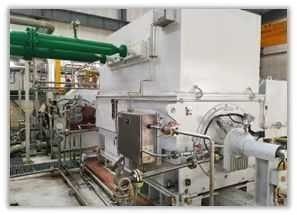
MCM's compressed-air and industrial-gas page separates variable-frequency induction machines from larger brushless synchronous machines. The published induction range of 500–40,000 kW, two/four/six poles and 6–13.8 kV is a catalogue envelope, not a stocked motor or a promise that its extreme values coexist. Starting against process pressure, train inertia and grid voltage dip may decide the motor and starter before nameplate power does.
Confirm before ordering Send compressor and gearbox data, load and acceleration curves, starting frequency, network fault and voltage-dip limits, ambient/cooling-water conditions, shaft coupling, bearing arrangement and process shutdown duty. Ask for one defined machine drawing and a witnessed train-start and heat-run test scope.
View Medium-voltage induction motors for compressors →
Rolling mill: distinguish overload from continuous output
For metallurgy MCM lists AC induction and synchronous variable-frequency routes, with torque ranges on its application page rather than one named orderable frame. Mill stands impose reversing, shock load, sustained low-speed torque and cooling challenges unlike a steady compressor. A broad torque headline cannot establish the allowable overload cycle of a specific winding or shaft.
Confirm before ordering Provide stand arrangement, torque-speed and reversing cycle, overload magnitude and duration, converter waveform, cooling supply, shaft and foundation drawings, site altitude and the existing drive's protection settings. Request a project-specific thermal and mechanical duty assessment.
Transformer testing: procure a system boundary
The separate test-equipment page describes design, manufacture, installation and commissioning of transformer-test motor-generator groups and their control equipment. This is a test-station integration scope, not a substitute for a production motor. The buyer must define the test waveform, frequency, duty, measurement chain, protections and who accepts each subsystem.
Confirm before ordering Share the transformer test standards and test object ratings, required 50/60 Hz or intermediate-frequency operation, short-circuit duty, power quality, control and metering interfaces, site power supply, FAT/SAT criteria and commissioning responsibility.




 LinkedIn
 Facebook
 X
 WhatsApp
 Email