

Buying a motor for a crane, hoist or steelworks travel drive starts with the motion cycle, not a catalogue power value. Lifting, lowering, travel and holding can place different demands on the motor, drive, gearbox and brake. A purchase brief that names only “crane motor, 15 kW” leaves suppliers to guess the starts, accelerations, loaded time, control method and mechanical interface. Quotations built on those different assumptions cannot be compared fairly.
This guide is a buyer's worksheet for the first technical discussion. It does not size a safety-critical lifting system. The equipment designer and qualified drive specialist must verify the complete machine, including holding and emergency-stop behavior, against the applicable project requirements.
Record one operating cycle before choosing a series
Describe each movement separately: hoist up with a representative load, lower, hold, trolley travel and bridge travel if they share the sourcing package. For every movement, record load, distance, target speed, acceleration and deceleration, running time, pause and expected cycles per hour. Identify the worst credible operating condition and whether the load can drive the motor during lowering.
This matters because the effective thermal demand is not defined by a headline output alone. IEC 60034-1:2026 concerns rotating-machine ratings and performance. Ask each supplier to state the proposed motor's duty designation and the conditions under which its rating applies. Do not copy a duty label from a catalogue family onto a particular ordered motor without the relevant datasheet and cycle review.
For a retrofit, attach the old nameplate and a measured cycle, but distinguish the old machine's rating from the new design requirement. A replacement that matches a shaft diameter yet overheats under the actual cycle is not an equivalent replacement.
Separate running torque, starting demand and holding
The motor, gear unit and brake solve different parts of the motion problem. Give the supplier the available load and gear data, plus the required acceleration. Ask for the proposed maximum and effective operating points on the motor side and the assumptions used to translate the load through the transmission. A catalogue torque peak is not a continuous rating.
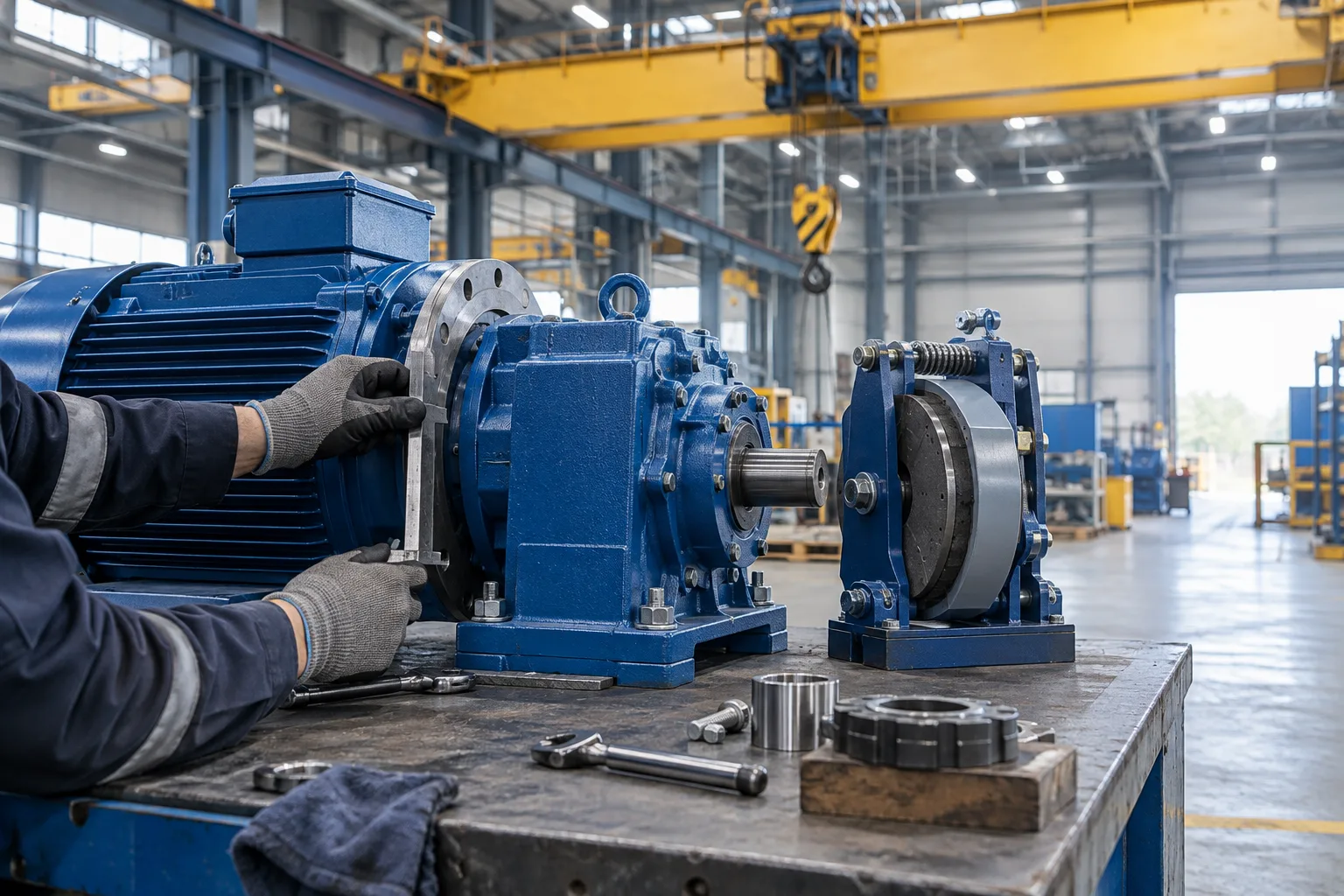
If the equipment lifts a suspended load, specify the holding and controlled stopping functions independently. SEW-EURODRIVE's project-planning method treats brake selection as part of hoist-drive selection and examines holding reliability, braking work and stopping distance. Have the responsible engineer check the brake, control sequence and emergency-stop cases as a system. A motor with a brake shown in a photograph does not establish the brake's supplied torque, release voltage or permissible duty.
Ask each supplier to identify which part of the package is included: motor, gearbox, service brake, control unit, brake resistor, encoder, cabling and protection devices. Keep exclusions in a separate list so a low motor-only quotation is not mistaken for a complete hoist drive.
State the control scheme and electrical boundary
Tell suppliers whether the drive is direct-on-line, wound-rotor or inverter controlled; include supply voltage, frequency and the existing or proposed converter details. For inverter operation, request the operating speed range, control mode, cooling approach at low speed, feedback requirements and motor insulation suitability for the proposed converter and cable arrangement. Have the supplier identify where a regenerative or braking resistor solution is needed rather than assuming the motor price covers it.
The series names on this site illustrate why this step matters. Shanghai Crane Motor Factory's profile distinguishes wound-rotor crane families from inverter-oriented crane families in its published catalogue. This is a range-level distinction, not a statement that every frame or variant is suitable for a particular hoist. Xindali's YZR wound-rotor series and Wuxi Hongtai's YZ crane series are further starting points for comparing actual offers. Ask each manufacturer to name the exact configuration, controller and operating limits it proposes.
Verify fit, environment and documentation
Provide a drawing of the mounting feet or flange, shaft, keyway, coupling, gearbox interface and available installation space. Identify the enclosure, cooling, ambient temperature, altitude, dust or moisture exposure and any project-specific hazardous-area classification. The scope of an efficiency class or standard should not be assumed from a generic “industrial motor” label; ask which declared ratings and documents apply to the exact offer.
Request a dimensioned outline drawing, connection diagram, motor and brake datasheets, declared duty, protection details and the acceptance-test scope. Keep revision identifiers beside the quotation. When a supplier offers a different frame, winding, brake or converter, compare the changed interface and operating assumptions, not just the new price.
Send a quotation brief that exposes differences
Use one worksheet for every supplier: machine function and load profile; movement cycle; electrical supply and control; mechanical envelope; brake and safety functions; operating environment; required documents; quantity, destination and delivery basis. Mark each field as provided, supplier-proposed or still open. Ask for the exact motor code and separate prices for the motor, drive, brake, gearbox, commissioning and spare parts as applicable.
The motor RFQ checklist gives a broader procurement template. Use it alongside this crane-specific cycle description, then shortlist manufacturers and send the same technical brief through the buyer inquiry form. A useful result is not a claimed “best crane motor”; it is a traceable proposal whose duty, interfaces and exclusions can be checked by the project's engineering team.
Sources & editorial notes
Prepared by the MotorSourcing Editorial Team from reviewed reference materials. This guide supports supplier discussions; the chosen manufacturer's model-specific documentation remains the reference for procurement and installation.
- IEC 60034-1:2026 — rotating electrical machines: rating and performance
- SEW-EURODRIVE — drive selection basic calculation process
- SEW-EURODRIVE — drive and gear unit selection data
- Shanghai Crane Motor Factory — official product range and YZB information
- Shanghai Crane Motor Factory — YZR wound-rotor and YZ cage-rotor distinction
For corrections, contact rfq@motorsourcing.com.
Ready to build your supplier shortlist?
Compare motor families and bring a complete specification to your next inquiry.
Find manufacturers → LinkedIn
 Facebook
 X
X WhatsApp
 Email
Email