

A motor directory usually begins with product families and series. That is useful for discovering manufacturers, but purchasing requires a more precise description. A series title can cover multiple ratings, dimensions and application variants, so the name alone should not be treated as a complete ordering code.
The distinction matters when comparing suppliers. Two pages may use a similar description while referring to different configurations. A clear inquiry identifies what is known, asks for what is missing and prevents a catalogue image from becoming the accidental specification.
Recognize the three levels of product information
A motor family describes a broad category, such as induction, brushless or geared motors. A series narrows the range to a manufacturer's product line. An exact model and configuration identify the version being offered, including the options and accessories that belong to that quotation.
Official catalogues may organize these levels differently. TECHTOP, for example, presents selection fields covering multiple electrical and mechanical attributes, while other manufacturers emphasize an application or a named series. Use the supplier's own ordering documentation to resolve the final configuration.
Do not assign one rating to an entire series
If a source page describes a range but does not provide a model-specific power, speed or voltage, leave the field open. Copying a rating from a neighboring model can make the listing appear complete while giving the buyer the wrong information. “Model dependent” is a more useful answer when accompanied by a clear request for the relevant datasheet.
Send the operating conditions that matter to your machine and ask the manufacturer to select a candidate model. Request the conditions associated with the stated ratings, including the operating duty and any limitations identified in the supplier's documentation. Keep continuous operating requirements separate from short-duration conditions.
Check the mechanical configuration
A matching series name does not establish mechanical interchangeability. Ask for shaft dimensions, mounting details, flange information and the overall envelope of the quoted motor. If it connects to a gearbox, coupling or existing assembly, include that interface in the drawing review.
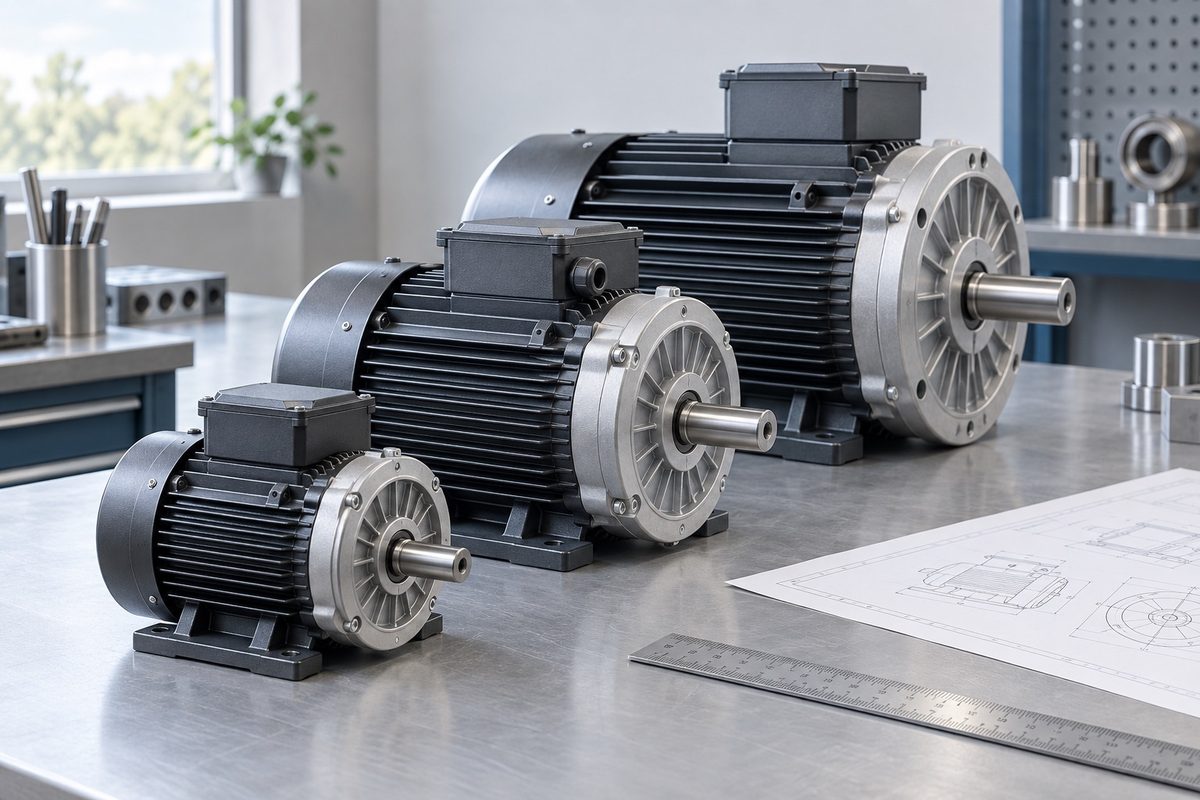
Where a catalogue picture shows a brake, fan, terminal box or connector, confirm whether it is included and whether its position matches the offered configuration. Product photographs often illustrate a range; the approved drawing and bill of materials should identify what will actually be supplied.
Identify the complete drive package
For controlled motion, clarify the boundary between motor and drive system. State whether your team needs a motor only, a matched controller, feedback devices, cables or a complete assembled drive. Ask the supplier to name compatible components and provide connection information for the proposed package.
If your project already uses a controller, provide its documentation and request a compatibility review. Do not infer that a similar connector or a matching headline voltage is enough to establish compatibility. Record who is responsible for integration and which questions remain for engineering validation.
Ask for a traceable quotation
A usable quotation should identify the exact product code, options, quantity and document revisions. Ask the supplier to list assumptions and deviations from your inquiry. Where a custom option is proposed, distinguish one-time development or tooling work from recurring production cost.
Save the quotation beside its datasheet and drawing. When a revised offer arrives, compare the technical changes as well as the price. An apparently minor model suffix can refer to an option that affects the assembly, so unresolved differences should be clarified in writing.
Use the directory to narrow the discussion
Begin with the motor family and the manufacturer's stated capabilities. Open relevant series pages, review their source links and add suitable manufacturers to your inquiry list. Then send a brief that includes your application, operating conditions and required documents.
The directory helps you reach the right technical conversation. The result of that conversation should be a confirmed configuration, supported by current manufacturer documentation and your team's acceptance process. That is the point at which a series-level search becomes a procurement-ready specification.
Sources & editorial notes
Prepared by the MotorSourcing Editorial Team from the references below. This guide supports supplier discussions; the chosen manufacturer's model-specific documentation remains the reference for procurement and installation.
For corrections, contact rfq@motorsourcing.com.
Ready to build your supplier shortlist?
Compare motor families and bring a complete specification to your next inquiry.
Find manufacturers → LinkedIn
 Facebook
 X
X WhatsApp
 Email
Email