

AC induction motors
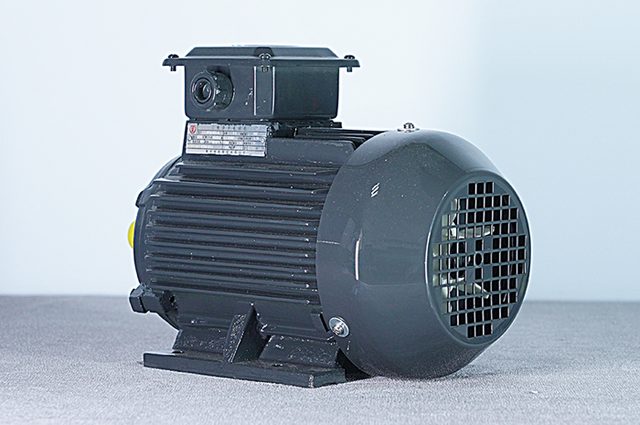
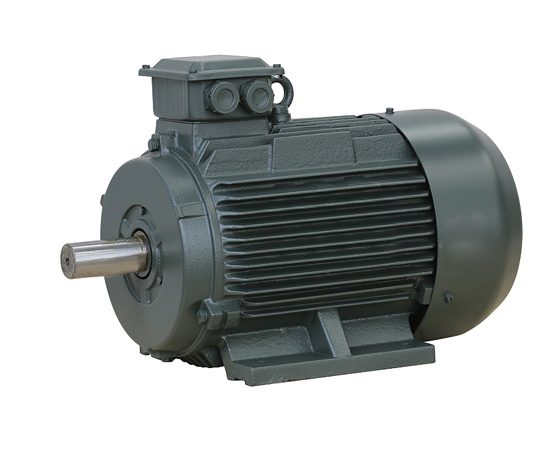
YE4 three-phase induction motor
HENGSHUI ELECTRIC MOTORS CO., LTD.- Power
- 0.55–315 kW
- Voltage
- 380 V
 0
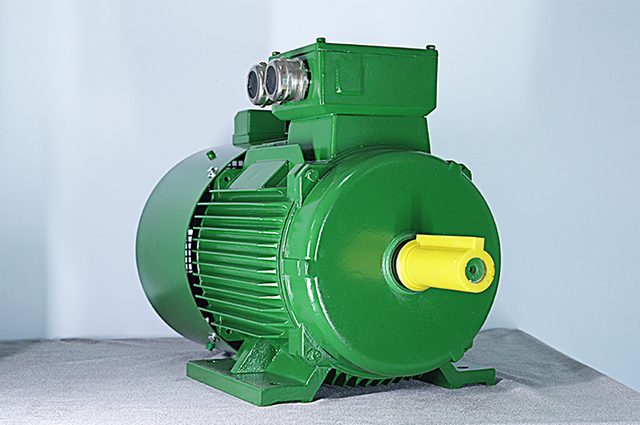
Manufacturer catalogue image · Series illustration

Catalogue series · Exact configuration and availability confirmed by the manufacturer.
A variable-frequency drive does not make the different YVF2 pole counts interchangeable. At the same 4 kW rating, Hengshui’s two-, four-, six- and eight-pole entries have different base speeds, currents, rotor inertias and installation lengths. Select the motor around the machine’s working speed and acceleration, then confirm the permitted frequency envelope for its exact designation.
These values are separate rows in Hengshui’s YVF2 technical table. L is the overall-length reference in the accompanying frame-size table. Inertia is the listed motor rotor inertia; it does not include the driven mechanism or coupling.
| YVF2 model | Base speed | Rated current | Rotor inertia | L |
|---|---|---|---|---|
| 112M-2 | 2,880 rpm | 8.31 A | 0.0058 kg·m² | 480 mm |
| 112M-4 | 1,435 rpm | 9.03 A | 0.0095 kg·m² | 480 mm |
| 132M1-6 | 960 rpm | 10.1 A | 0.0357 kg·m² | 570 mm |
| 160M1-8 | 720 rpm | 10.2 A | 0.0753 kg·m² | 660 mm |
The page heading and model table say YVF2, but the introductory operating-envelope text says YVFE2. The limits below are what that introduction states; have their applicability to the ordered YVF2 model confirmed. Do not silently treat the two designations as a documented revision or equivalence.
| Configuration in introduction | Stated constant-torque region | Stated constant-power region |
|---|---|---|
| Two poles | 3–50 Hz | 50–60 Hz |
| Four or six poles, excluding 355-4 | 3–50 Hz | 50–100 Hz |
| 355 frame, four poles | 3–50 Hz | 50–75 Hz |
| Eight-pole models listed in the table | Not separately established for this configuration | No eight-pole upper limit stated in the introduction |
The published operating sketch shows torque declining above the base-frequency transition. As an engineering relationship, if mechanical power remains constant while shaft speed doubles, torque halves. That arithmetic explains the trade-off; it is not a promise that every listed motor may double its speed. In particular, the stated two-pole and 355-4 limits are lower than 100 Hz.
The introduction describes an external cooling fan and an S1 continuous rating, with 380 V, 50 Hz, class F insulation and IP55 enclosure protection. A low-speed continuous-load order needs the fan supply, cooling arrangement and operating interlock specified along with the main motor. Do not assume the fan can be fed from the variable-frequency motor terminals or that a stopped fan preserves the stated continuous-load envelope.
The four 4 kW examples span 8.31–10.2 A even before considering application overload. Their rotor inertias also differ substantially. Supply the inverter vendor with the exact motor current, rotor and reflected load inertia, required acceleration, reversing frequency and braking duty. Selecting an inverter only because its label also says 4 kW leaves those differences unresolved.
The 4 kW eight-pole example has a listed L of 660 mm, compared with 480 mm for the two- and four-pole examples. Verify the delivered fan cover, terminal-box access, mounting form and shaft drawing against the machine. The catalogue’s outline sketch and length table do not alone prove that an existing standard motor can be replaced without bracket or coupling changes.
Give the required minimum continuous speed, maximum running speed, torque at each, ambient conditions and acceleration or deceleration time. Ask for confirmation against the exact YVF2 or YVFE2 nameplate and the proposed inverter settings. The catalogue’s locked-rotor and maximum-torque ratios are separate characteristics, not continuous torque permissions throughout the frequency range.
CATALOGUE OVERVIEW
Hengshui Electric Motors publishes the YVF2 variable-frequency three-phase motor family with model-table outputs from 0.55 to 315 kW. Its tables identify current, rated output torque, speed and rotor inertia for each listed model. The catalogue specifies 380 V, 50 Hz, class F insulation and continuous-duty ratings. Frequency-dependent torque and power limits vary by configuration; request the exact motor and inverter operating envelope, cooling arrangement and installation drawing for the intended speed range.
Specifications describe a series range; confirm which ratings apply together to the quoted model.
Confirm mounting and shaft dimensions against the drawing for the quoted configuration.
AC induction motors
AC induction motors
AC induction motors
AC induction motors
Keep your sourcing team on the same page.
We use cookies to keep this site working and measure website usage. Cookie & privacy details
 LinkedIn
 Facebook
 X
 WhatsApp
 Email