

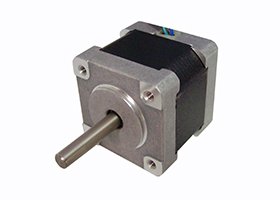
Stepper motors
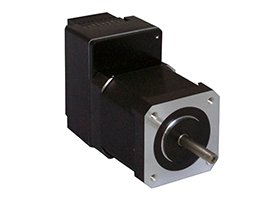
Two-phase hybrid stepper motor series
Beijing Senchuang Motion Control (SYN-TRON)- Step Angle
- 1.8°
- Example Model
- 42BYG250BK-0151
 0
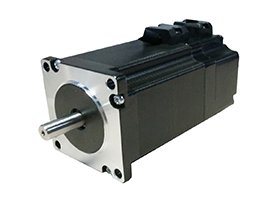
Manufacturer catalogue image · Series illustration

Catalogue series · Exact configuration and availability confirmed by the manufacturer.
The July 2026 56S catalogue lists three two-phase, 1.8° closed-loop stepper variants. They share an 8 mm shaft, but their current, inductance, mass and body length differ. Select the complete motor and compatible drive as an axis; the largest holding-torque figure is not automatically the best replacement for a compact, fast-cycling machine.
CK, DK and EK below mean 56SBYG250CK-SASSBL-0242, 56SBYG250DK-SASSBL-0242 and 56SBYG250EK-SASSBL-0602 respectively. L is the drawing dimension. Holding torque is static, not a running-torque curve.
| Parameter | CK · 0242 | DK · 0242 | EK · 0602 |
|---|---|---|---|
| Catalogue code | 034010 | 034020 | 034030 |
| Holding torque | 1.1 N·m | 1.8 N·m | 2.8 N·m |
| Static phase current | 2.4 A | 2.4 A | 6.0 A |
| Phase resistance | 1.2 Ω | 1.5 Ω | 0.5 Ω |
| Phase inductance | 4.5 mH | 6.2 mH | 2 mH |
| Drawing length L | 74 mm | 94 mm | 130 mm |
| Mass | 0.68 kg | 1.05 kg | 1.4 kg |
| Rotor inertia | 280 g·cm² | 440 g·cm² | 800 g·cm² |
A change from CK to DK or EK changes more than holding torque. Use the available mounting space, load and acceleration requirement to narrow the choice.
The outline has a 56.4 mm face, a 47.14 mm hole pattern and an 8 mm shaft for all three listed versions, but L grows from 74 to 130 mm. Check rear cable clearance and the drawing’s locating register as well as the bolt pattern. The manufacturer specifically requires register location and shaft alignment; matching screw spacing alone is not sufficient.
The published CK and DK curves are labelled for a 48 V drive and a 0.9° command step. They distinguish normal-operation and overload curves. Select the normal operating curve for sustained motion and check the actual speed/torque points; do not treat the overload line as a continuous rating. The catalogue’s nominal motor step angle remains 1.8°—the graph’s command setting is a different condition.
The EK row is 6 A per phase rather than the CK/DK 2.4 A, with higher rotor inertia and a longer body. Ask for its matching drive setup and operating curve before choosing it for higher acceleration. The visible CK/DK graphs do not establish EK performance, and a larger static torque does not by itself prove a faster move.
The current motor sheet names SS-20804 and SS-20806 Ver1.1 as typical matching drivers. Preserve that version qualification when reviewing an existing cabinet or a new quotation.
The naming diagram identifies the S after 56 as a 1000-line incremental encoder version; an omitted encoder designation is not the same motor configuration. Provide the full nameplate reference and the driver revision. A driver with the same general family name should not be assumed to have the required motor configuration.
The manual shows two motor/encoder wiring methods with different colour assignments. For example, the A− motor lead is green in one method and blue in the other. Identify the supplied harness method and use its complete connection drawing. Do not combine power-lead colours from one method with encoder colours from the other.
Include the selected full reference, existing drive and revision, supply, target speed, move distance, acceleration time, load/transmission details and space available for L. Add a photograph of the existing connectors for replacement work. Ask the offer to identify the motor, driver settings, wiring method and curve together, so the axis can be approved as a complete combination.
CATALOGUE OVERVIEW
The SYNTRON 56S family combines a two-phase hybrid stepper motor with feedback for use in a compatible closed-loop drive system. Published holding-torque options are 1.1 / 1.8 / 2.8 N·m, depending on the motor length and winding. The catalogue specifies a 1.8-degree step angle and class B insulation.
Provide the required running torque, speed, inertia and positioning cycle when requesting a quotation. Confirm encoder compatibility, cable pinout and the chosen driver together with the motor; feedback does not remove the need to size the axis mechanically.
Model / series reference: 56S
Specifications describe a series range; confirm which ratings apply together to the quoted model.
Confirm mounting and shaft dimensions against the drawing for the quoted configuration.
Stepper motors
Stepper motors
Stepper motors
Stepper motors
Keep your sourcing team on the same page.
We use cookies to keep this site working and measure website usage. Cookie & privacy details
 LinkedIn
 Facebook
 X
 WhatsApp
 Email