

Motor parts & accessories
SD digital stepper driver series
Beijing Senchuang Motion Control (SYN-TRON)- Product Type
- Stepper driver
- Example Model
- SD-20504EK
 0
Manufacturer catalogue image · Series illustration

Component reference · Confirm the exact hardware and interface revision.
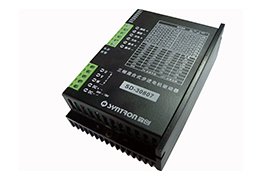
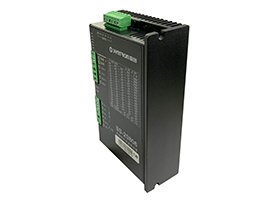
This is the standard two-phase closed-loop driver SS-20806, catalogue code 001527. Its manufacturer-linked manual identifies 86SBYG250BS and 86SBYG250DS motors with a 1000-line incremental encoder. The similarly named N and SK drivers are separate products; their wiring and feature lists should not be used to approve an SS-20806 replacement.
The official six-page manual is marked January 2016 and remains linked from the standard model’s product page. Check the delivered revision when ordering, especially a unit carrying a custom Ver suffix.
| Item | Manual value | Selection meaning |
|---|---|---|
| DC supply operating range | 24–70 V DC | Protection thresholds do not extend this operating range |
| Maximum output current | 8.0 A peak per phase | Not 8 A RMS and not the required DC supply current |
| Named motor matches | 86SBYG250BS / 86SBYG250DS | Match full motor and feedback details before substituting another motor |
| Encoder | 1000-line incremental | Line count alone does not establish connector pin compatibility |
| Command resolution | 16 selections, 200–25,600 steps/revolution | Set the controller’s pulse-to-distance scaling to the chosen resolution |
| Driver envelope | 142 × 78.8 × 39.8 mm | Reserve ventilation and wiring space around the enclosure |
The manual specifies a 200 kHz input response, pulse/direction control and a direction setup time of at least 2 µs. Electrical command capability is separate from the motor’s mechanical torque-speed capability.
At 25,600 command steps per revolution, a 200,000-pulse/s ceiling corresponds to 200,000 ÷ 25,600 × 60 = 468.75 r/min. This is a calculated command-rate limit, not a promised motor speed. A controller with a lower output rate gives a lower limit; the motor load and available torque may constrain speed further. Choose resolution together with the required travel speed instead of automatically selecting the largest number.
The driver needs about one second for power-up self-check before responding normally. The manual says resolution-switch changes take effect after repowering. Coordinate startup sequencing and controller scaling so the machine does not send its first move before the driver is ready or continue using the old steps-per-distance value.
The standard interface is single-pulse plus direction; a dual-pulse requirement is a custom configuration in this manual. The input section describes TTL, open-collector and differential arrangements over a stated 3–24 V signal range. Ask for the connection diagram matching the controller output and delivered driver, including pulse width and direction timing.
The manual explains that higher supply voltage can improve high-speed torque while increasing driver loss and temperature. Its peak phase-current figure must not be used directly as the supply-current requirement. Give the motor reference, acceleration, maximum load and number of simultaneously moving axes so supply capacity and voltage rise during deceleration can be reviewed.
These indications come from the standard SS-20806 manual. They help describe a fault to support; they do not establish its cause. Inspect wiring with power isolated and resolve the fault before a supervised restart. Do not bypass protection to keep the machine running.
| Red LED | Manual indication | Useful evidence for the inquiry |
|---|---|---|
| Steady on | Overcurrent | Supply conditions, motor reference and when the fault appeared |
| Three slow flashes | Motor or encoder connection missing | Connector condition and complete motor/encoder identification |
| Four slow flashes | Undervoltage, below 20 V | Measured bus voltage under load and supply capacity |
| Five slow flashes | Overvoltage, above 90 V | Whether the fault occurs during braking; 90 V is a trip threshold, not an allowed supply |
| Two fast flashes | Position following error | Command speed, acceleration, load and observed obstruction |
| Four fast flashes | Prolonged motor overload | Duty cycle, load and cooling conditions |
CATALOGUE OVERVIEW
The SYNTRON SS-20806 is a closed-loop stepper driver with a published 24–70 V DC supply and support for a 1,000-line incremental encoder. Its control system adjusts motor current with load and includes alarm monitoring.
Confirm the compatible motor and encoder wiring, required pulse input and current limit with the manufacturer. The manufacturer’s Chinese SS-20806 manual specifies a maximum peak output of 8.0 A per phase; this is not an RMS current or a DC supply-current rating. Match the standard model and manual revision before integration.
Model / series reference: SS-20806
The values below refer to this model; check the supply and mounting of the offered assembly.
Confirm enclosure dimensions and electrical interfaces for the quoted revision.
Motor parts & accessories
Motor parts & accessories
Motor parts & accessories
Motor parts & accessories
Keep your sourcing team on the same page.
We use cookies to keep this site working and measure website usage. Cookie & privacy details
 LinkedIn
 Facebook
 X
 WhatsApp
 Email