

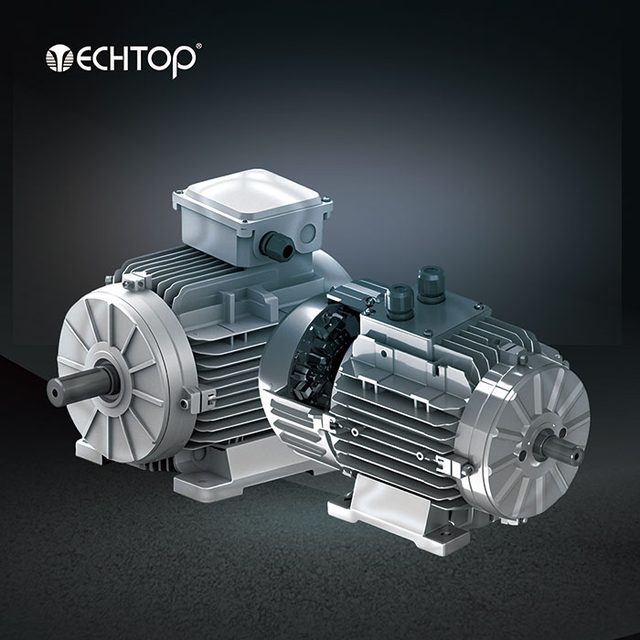
Permanent magnet motors
Permanent magnet synchronous motor
Shanghai Top Motor Co.,Ltd.- Motor Type
- Permanent-magnet synchronous
- Catalogue Series
- EC / ECI
 0
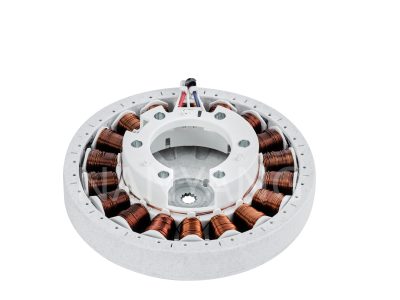
Manufacturer catalogue image · Series illustration

Catalogue series · Exact configuration and availability confirmed by the manufacturer.
Nanyang’s outer-rotor DD family is presented for front-loading washing machines in the 8–25 kg class. It drives the tub directly without a belt-and-pulley stage. The published 36-slot, 48-pole design is therefore an appliance-integration choice: the wash cycle, spin cycle, drum connection and inverter must be specified together. The family’s largest torque and speed values are not a single rated operating point.
These entries come from the DD family table. No individual winding code or paired torque-speed curve is provided, so the ends of each range should remain separate selection limits rather than a complete motor rating.
| Selection item | Wash duty | Spin duty |
|---|---|---|
| Published torque | 15–50 N·m | 2.5–4.5 N·m |
| Published motor efficiency | ≥45% | ≥75% |
| Speed evidence | No wash-specific rpm given | Whole-family envelope is 0–1,600 rpm; no torque-to-speed pairing |
| What the application must supply | Drum load and reversal cycle at required wash speed | Target spin speed, acceleration time and unbalanced-load behaviour |
Using P(kW) = torque(N·m) × speed(rpm) ÷ 9,550, a hypothetical 50 N·m at 1,600 rpm would require about 8.38 kW of shaft power. This is a calculation to expose a mistaken combination, not a product rating. The same family table lists power as 0–3/4 HP and separates wash from spin torque. It does not support combining maximum wash torque with maximum family speed.
A useful request states the required wash torque at wash rpm, then the spin torque at spin rpm, together with acceleration and reversal intervals. Ask for a selected winding’s torque-speed curve and thermal-duty qualification covering those points. The published 8–25 kg appliance range is context for the family, not proof that one motor configuration suits every drum in that range.
The wash and spin efficiency entries describe motor performance categories. They do not state test load points or establish a complete appliance energy rating. Compare quotations using the same wash/spin operating points and the same inverter losses; do not turn either percentage into a promised household electricity saving.
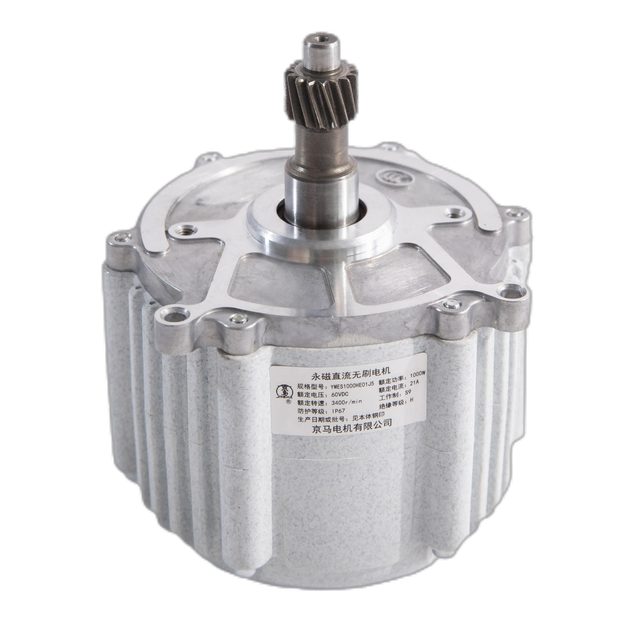
The table states 310 V DC, 36 stator slots and 48 rotor poles. It does not specify the inverter output current, feedback pinout or winding resistance. Request those values and the compatible control arrangement; 310 V DC is not a description of a household AC connection. Do not infer connector functions from the product photograph.
The source lists 6202/6201 bearings and maximum external dimensions as 290.2/297 mm, without mapping each value to an individual revision. It also lists iron/PP construction. Ask which bearing arrangement and envelope belong to the offered assembly, then compare the tub mounting, rotor attachment and drum-shaft interface on a dimensioned drawing. An outside diameter alone does not establish interchangeability.
Agree on tests for loaded wash reversals, transition to spin and the intended unbalanced-load condition. Record the actual appliance capacity and cycle durations. Direct drive removes the belt stage, but it does not by itself establish vibration, acoustic performance or controller compatibility in a particular washing machine.
CATALOGUE OVERVIEW
Nanyang's DD catalogue describes an outer-rotor BLDC motor for front-loading washing machines with 8–25 kg capacities. The published table identifies horizontal direct drive, 310 V DC supply, 36 stator slots and 48 rotor poles. Its listed speed envelope is 0–1600 rpm.
Wash torque is given as 15–50 Nm, while spin torque is listed separately as 2.5–4.5 Nm. The power entry is expressed as 0–3/4 HP; request the selected model's rated output in watts before making a power-based comparison. Check drum coupling, installation dimensions and controller compatibility against the appliance drawing, because the family table covers multiple configurations.
Specifications describe a series range; confirm which ratings apply together to the quoted model.
Confirm mounting and shaft dimensions against the drawing for the quoted configuration.
Permanent magnet motors
Permanent magnet motors
Permanent magnet motors
Permanent magnet motors
Keep your sourcing team on the same page.
We use cookies to keep this site working and measure website usage. Cookie & privacy details
 LinkedIn
 Facebook
 X
 WhatsApp
 Email